
01 / Design
Engineering design
Develop an idea, refine existing CAD or solve a practical mechanical design problem.
- CAD models & engineering drawings
- Product & mechanical development
- Design changes & manufacturing review
Independent engineering · Sheffield, UK
Design → Build → Develop
Mechanical design, CAD, prototyping and fabrication, with electronics and systems development when your project needs more.
From a single part to a working prototype. Based in Sheffield, working with customers across the UK.

Research-led engineering
In-house design & build
Based in Sheffield
NDA-friendly discussions
What we do
Bring us the work you need done, whether that is refining a design, making a batch of parts or developing a complete prototype.
Develop an idea, refine existing CAD or solve a practical mechanical design problem.

Get a one-off component, a functional prototype or a small batch made in our workshop.

Bring mechanical hardware, electronics and software together into a working system.
Selected projects
From a custom component to an inspection system or a data-led feasibility study. A closer look at the problems we work on and what we build.
01 / Machine vision & measurement
In-house R&D · Working prototype
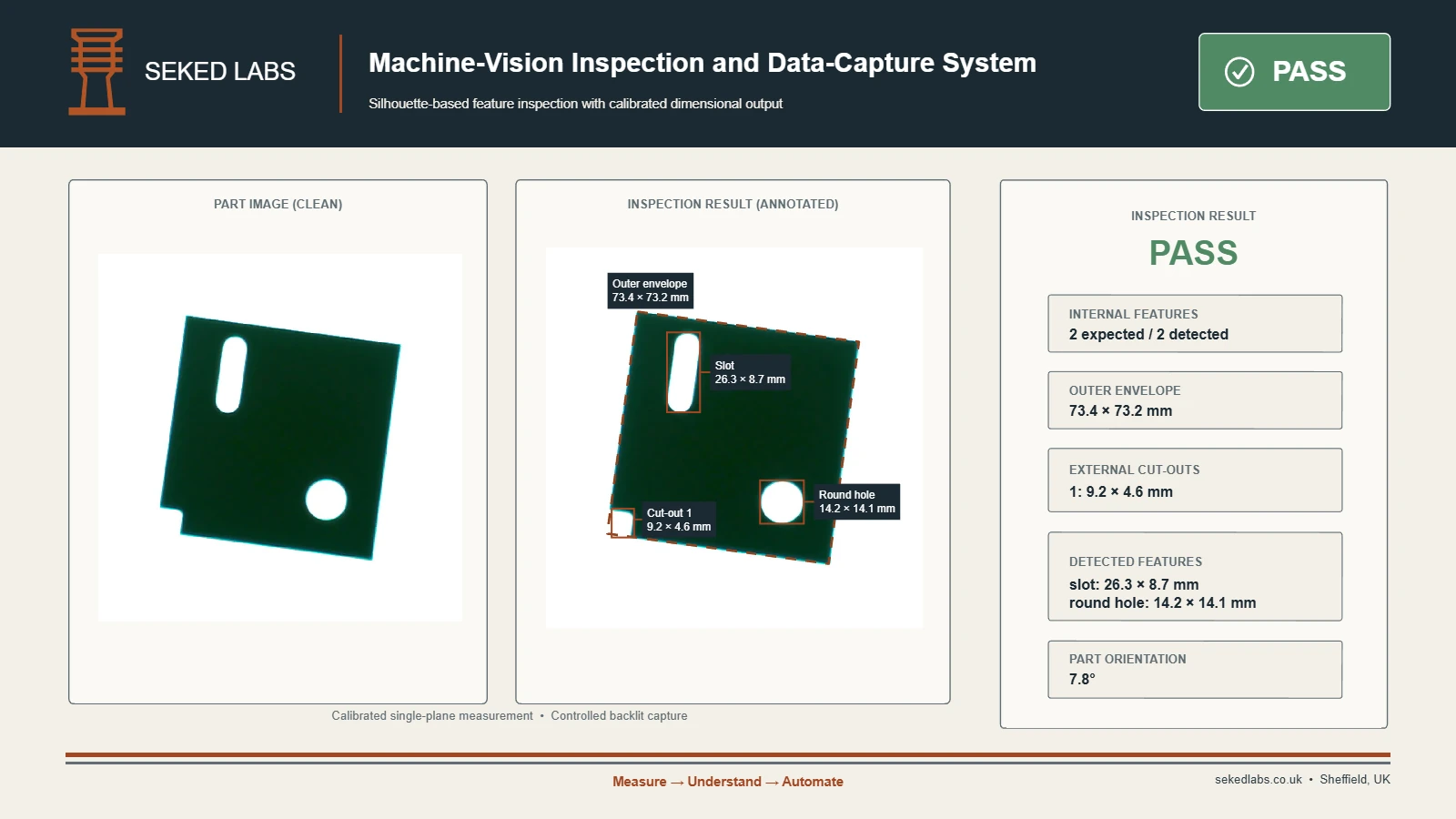
Checking holes, slots and profiles by hand can become repetitive. We developed a camera-based rig that captures a part’s silhouette, measures its features and records the result in a consistent report.
The prototype brings camera positioning, lighting and software into one workflow. Image processing identifies the outer profile, round holes, slots and edge cut-outs, then converts the image measurements into dimensional outputs.
Test coupons include deliberately altered features to exercise the inspection logic. The report combines the captured image, detected geometry and check results, so each decision can be reviewed.
Current stage: working prototype tested on controlled parts. Application-specific accuracy and repeatability validation is the next stage.
02 / Data analysis & control
Confidential feasibility work · Simulation stage
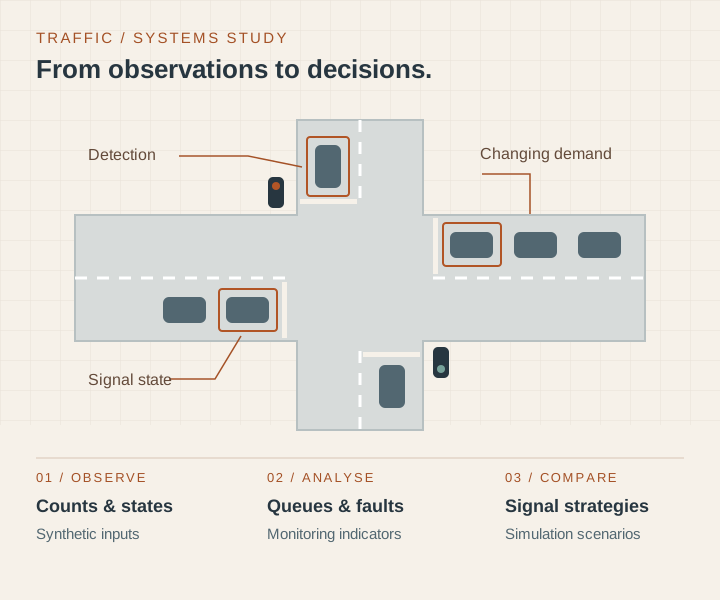
Traffic measurements can help explain where queues build and how junctions respond to changing demand. We developed a simulation-led study to explore monitoring, fault detection and alternative signal-control strategies.
The monitoring work explores how vehicle counts, speed, occupancy and signal states can be brought together to describe junction behaviour. Synthetic congestion and sensor-fault scenarios provide known conditions against which to examine the analysis.
A separate simulation compares fixed-time timing with a traffic-responsive strategy under changing demand. The work provides a basis for evaluating how signal operation uses available capacity before progressing to validation with operational data.
Current stage: feasibility demonstration using synthetic data and simulation. Operational validation is a future stage. Identifying project details are confidential.
03 / Mechanical design & fabrication
Customer project · Parts supplied
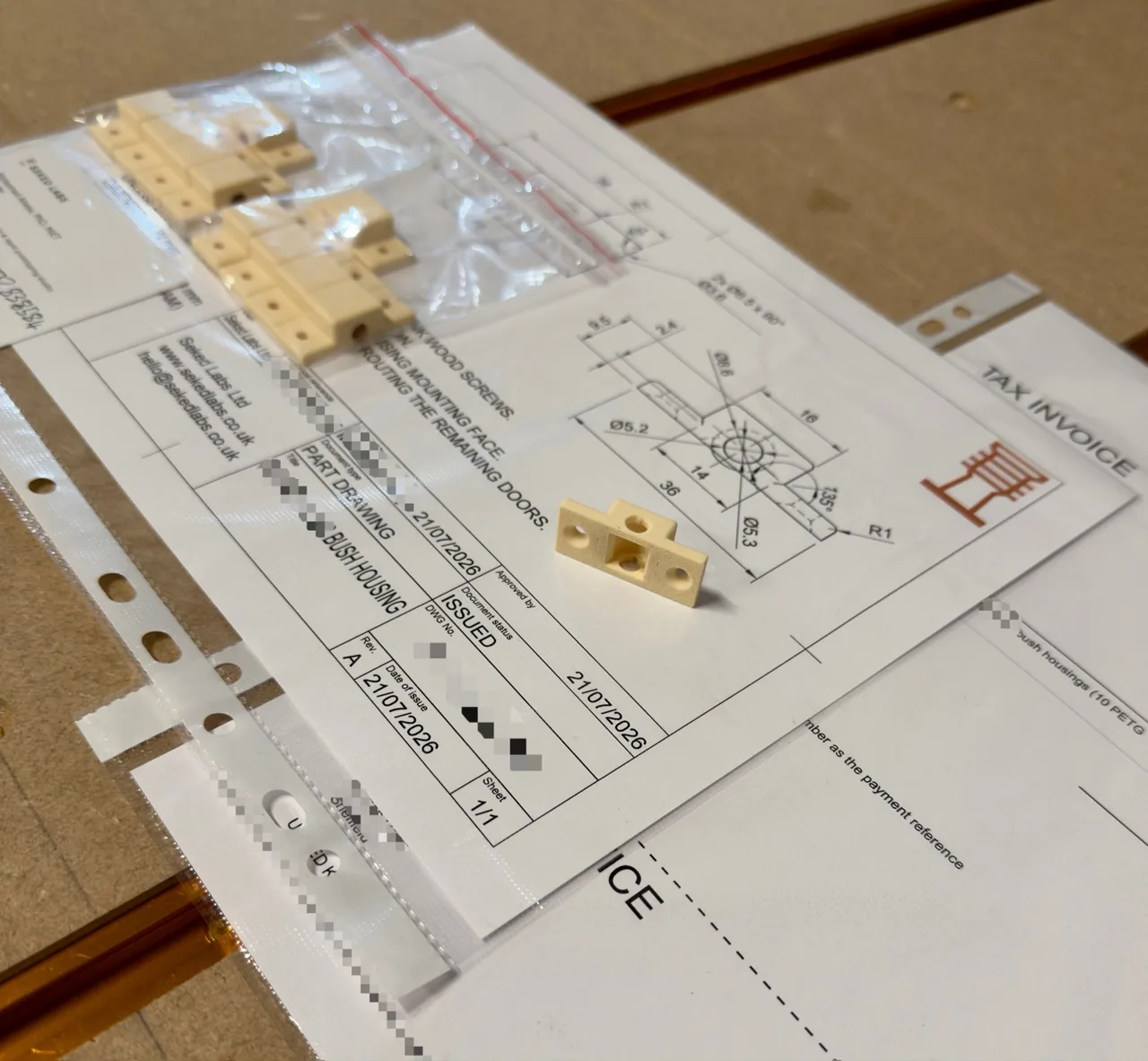
A customer needed a bushing housing with no suitable off-the-shelf option. We developed the geometry around the assembly, documented the design and manufactured a small batch in our Sheffield workshop.
The housing needed to support the bushing axis and maintain clearances within the surrounding assembly. The design included a feature less than 1 mm thick, so geometry and the manufacturing approach were considered together.
CAD, the engineering drawing and in-house manufacture formed a connected workflow. The customer received the completed parts without having to coordinate separate design and fabrication suppliers.
In-house capabilities
CAD, electronics and in-house fabrication keep design, build and iteration connected. Order standalone parts, bring an existing design for refinement, or work with us through several iterations.
How we work
Research-led thinking, grounded in practical engineering. Our experience spans additive manufacturing, sensing, robotics and applied machine learning.
About Seked LabsClarify the requirement, constraints and what a useful result should look like.
Design, fabricate and integrate the hardware and software around the application.
Evaluate the result, document what we learn and agree the next iteration.
Start a conversation
Send a drawing, describe a problem or talk us through your idea. You do not need a finished brief.